

#465 | Term and Optionality

In #463 | A Tale of Two Term Markets, Kasey Gammons broke down the Term market into two distinct spheres. One of them is based on pure price competitiveness at the expense of features that arguably give Term its greatest value—conversion privileges. The other is less about price and more about providing long-term value to policyholders. This week, we have the second part in our Term series which looks at how securing viable conversion privileges can best serve the needs of clients but requires us to look past price alone. Lastly, we also consider the important role that Return of Premium policies can play in giving clients much-needed coverage optionality later in life.
By Paul Hanley
In the world of financial planning, one of the key goals for advisors is to create strategic optionality for clients—especially near or during retirement. Having a well-positioned, layered array of assets, products and tools helps offer flexibility in navigating ever-changing situations and environments. For the adept advisor, this mantra is preaching to the choir and probably goes without saying. But in the context of life insurance, creating optionality for the client comes with its own unique set of complexities with regard to the associated cost, functionality, and tradeoffs of each product or feature. While consumers are understandably keen on paying the least for the most protection, frugality often comes at a cost—and in ways that are not always immediately obvious.
When it comes to Term, conversion privileges are the most likely thing to be sacrificed in products with rock-bottom pricing. Recently in #463 | A Tale of Two Term Markets, we saw a classic example of the “price-trap” phenomenon: Banner is almost always at the top of the heap for Term affordability, but has only one conversion product which is exorbitantly priced. Not the kind of optionality I would want to have for my own protection needs. By playing the price-only card on the front end, we may be leaving the client hamstrung with limited (or no) viable coverage options on the back end. In many instances, a Term product with more generous conversion flexibility may only cost an additional 10% or so over cut-rate Term—although you might have to look far down on the quote screen past the companies fighting for a few pennies of price advantage. Although solid convertibility options are absolutely worth the modestly higher price tag, it is up to the agent to vet products and carriers—which is much more involved than just running quotes.
It has long been argued at TLPR that convertibility is the most valuable feature of Term insurance, but it’s highly unlikely that the client would naturally arrive at that conclusion on their own. Consumers are so conditioned to view life insurance as a price-only commodity that it is up to the agent to drive home the greater value these products offer beyond mere temporary death benefit protection. But as carriers become increasingly wary of mortality risk, restrictions on conversion privileges have been getting tighter (see #352 | The Walls Are Closing in on Term Conversions). This is done by limiting the conversion window period, offering separately priced convertible and non-convertible Term, forcing policyholders into lackluster conversion-only permanent products, or even capping the rate class upon conversion.
If a policyowner has experienced deteriorating health or otherwise becomes uninsurable, they may be relegated to paying astronomical premiums to continue coverage past the level-term (LT) period—or having the coverage lapse completely if they have not already converted. In #248 | The Price of a Term Conversion, we saw that perhaps as few as 1% of people die while holding Term coverage, which means that an insurability event is far more common than a mortality event during the LT period. In other words, the more generous the conversion privileges are in a Term policy, the more the agent helps the client to insure future insurability. The slight additional cost of a reasonably priced, conversion-friendly product could absolutely be worth its weight in gold when the client needs or wants to extend coverage—and could save them thousands in getting a better permanent product.
But the sobering reality is that the conversion privilege is grossly underutilized by policyholders, as shown in a recent study from the Society of Actuaries (May 2026). When looking at 10-year term policies from 2015-2023, SOA finds that the conversion rate lies somewhere in the low single digits. This may partly be attributed to carriers restricting conversion privileges, but also to a lack of agent/client awareness of the feature itself. Unfortunately, insurers are not required to send out letters to policyholders announcing the conversion window is closing. This is where the advisor can add significant value at each annual review by tracking and reiterating the benefits of conversion. Staying ahead of the curve can help prevent client “sticker shock” when the LT period ends, while creating a natural opportunity for a new sale. Think of it as enlightened self-interest.
The low incidence of conversions is astonishing given how useful the privilege can be as people move into new life stages. Think about how a parent’s view on protection shifts when they realize their special needs child will not be able to live independently as an adult. Or the 40- or 50-something client who suddenly suffers a major health setback and realizes they want to extend coverage beyond the LT period. Maybe folks just want to leave a tax-free legacy to their children or fund their grandchildren’s education. The problem is that the client’s potential motivations for acquiring permanent coverage can be difficult—if not impossible—to foresee at the Term point of sale.
This means that the Term product an agent recommends today may be the single determining factor in the client’s permanent coverage options moving forward.
Although less-restrictive Term convertibility is key in helping the client “insure insurability”, another often overlooked option is return of premium (ROP) policies. Once fairly common with several major carriers, ROP today is a highly niche product that is relegated to a handful of smaller insurers in the heartland to carry the torch.
ROP is a very unique but largely misunderstood product class with a deceptively simple premise: after the LT period, you receive all eligible premiums back as a tax-free return of basis. Some may see this as a great way to not “lose money” on life insurance coverage. Others may be more skeptical. While discussing ROP at a group dinner a few years ago, one advisor said to me, “That’s like overpaying on my cable bill every month and having the company pay it back to me after 20 years. Why would I do that?” On the surface, this is an understandable objection from a financial advisor’s point of view because of the time value of money. But his comment sorely overlooks the real strength and flexibility of the product.
From the client’s perspective, getting their “money back” if they outlive the LT period is likely the shiniest optic, as it may psychologically keep them from feeling like they paid premiums all those years for nothing. But since ROP comes at a significant cost premium over traditional Term, advisors are understandably leery of tying up more of their client’s money if the apparent benefits don’t seem to stack up. Again, as with traditional Term, sheer frugality on price can lead us to overlook ROP’s unique coverage optionality. Agents must be able to smartly frame the total value proposition to clients, which can be difficult since the available products vary considerably from each other—with no uniform chassis on which they are built.
We have found four carriers currently offering ROP products: Assurity, Illinois Mutual, Cincinnati Life and Kansas City Life. Unfortunately, trying to figure out which gives the most bang for the buck is neither easy nor intuitive.
For starters, ROP illustrations typically include a calculation which takes the difference between the cost of the carrier’s ROP and standard Term and generates a hypothetical rate of return you would have to earn on the spread in order to equal the amount of the refunded premium at the end of the LT period. For instance, let’s assume the standard Term premium is $100/month and the ROP is $250/month. The hypothetical rate of return would tell us the interest rate we would have to earn by investing the difference of $150/month in an alternative savings vehicle for the entire LT period in order to end up with the total amount of premium returned to the policyowner.
Ironically, if the carrier’s standard Term is not competitively priced, it will mean a smaller spread in cost between it and their ROP product—which can artificially inflate the hypothetical rate of return. Illinois Mutual’s illustration says that the policyholder would have to earn 4.84% on the additional cost of ROP over their traditional Term to end up with the total returned premium for a 45/male PNT on a 30-year plan with $500k face. Initially, this looks like a very attractive, tax-free “yield”. But rather than relying on the carrier’s own internal pricing, we equalized the calculation by taking the median premium of the 15 cheapest Term products as our benchmark. The spread between the median market price and each carrier’s ROP premium becomes the basis for the rate of return necessary over the LT period to end up with the total returned premium.
We have included the hypothetical rate of return in the table below, along with other key figures for each carrier’s product:
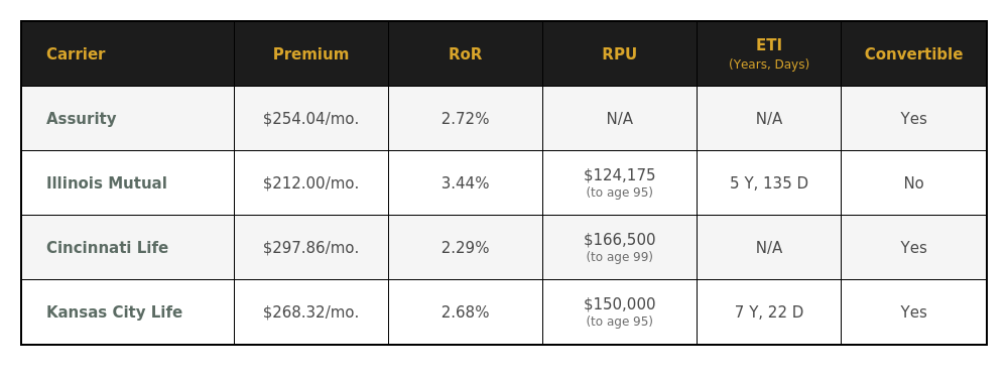
Notice that Illinois Mutual’s calculation drops by 140bps when we compare the cost of their ROP to a more competitively priced Term product—although it still leads the pack strictly in terms of rate of return. At first glance, the plus-or-minus 3.00% hypothetical yield across the four products may not seem very impressive. In today’s higher interest rate environment, there may even be a good argument for carriers adjusting their pricing to tilt that number more in favor of policyholders. But in my view, the greatest value of the ROP product—at least from the perspective of the recommending agent—should not be primarily as an alternative savings vehicle, since that goal can be achieved in myriad other ways.
So, the big question is: If the implied rate of return is no better than, say, a CD or high-yield savings account, then why would anyone want to put the extra money into an ROP?
The answer is that the biggest benefit of standalone ROP products is not the return of premium itself. Instead, because cash value accrues like a permanent policy, carriers are statutorily required to offer policyholders potentially valuable non-forfeiture options to continue coverage at the end of the LT period at no cost. These products essentially have a bundled, dual-purpose premium that provides death benefit protection as well as incremental policy value growth which gives you the contractually guaranteed ability to extend coverage in later years with no further premiums or underwriting. Importantly, the non-forfeiture options can be elected whether the policy’s conversion window has closed or not. Think about how powerful that could be for your client when their health has suddenly gone south and they don’t want to lose their coverage.
For this reason alone, I would argue that ROP absolutely merits at least some consideration in many traditional Term placements because of its unique ability to extend protection beyond the LT period. If convertibility is arguably the most valuable feature of Term insurance, then so, too, are the non-forfeiture options with ROP.
Therefore, instead of comparing against investment alternatives, I would argue that the price differential between ROP and traditional Term is best framed as the cost of securing a guaranteed hedge against insurability and mortality risk via the non-forfeiture options. In this context, the fact that the additional premium for ROP generally “yields” a hypothetical return which is basically on par with the long-term inflation rate seems more like a bonus than a bust. And if the client chooses, at the end of the LT period they could potentially walk away with 100% of refundable premiums while losing very little (if any) of their money’s relative purchasing power.* That is the kind of optionality which no traditional investment could provide—and no rate of return can quantify.
But the biggest challenge for agents is that the available carrier offerings are all over the place in terms of design and are quite nuanced in their features and specifications. Having a complete understanding of exactly how the products work under the hood is the biggest obstacle to convincingly positioning ROP as a robust alternative to traditional Term. Since the hypothetical yield is not the real tour de force, agents need to be able to deftly position the product features which give ROP its greatest value proposition.
The four product offerings we have found generally lie on a continuum from the least to greatest optionality in terms of convertibility, as well as the Reduced Paid-Up (RPU) and Extended Term Insurance (ETI) options shown in the table above.
Assurity offers ROP via a separate rider on their Term Life product but, unfortunately, there are no non-forfeiture options. And despite the return of premium, there is no cash value accrual and therefore no loan provision. I think this is one instance where the cable bill analogy legitimately applies. Why would I choose to tie up the extra money to get my premium returned without also having the option to continue coverage at no cost past the LT period? It’s probably no stretch to say that the shock-lapse rate on a 20- or 30-year policy would be astronomical and leave many people with no viable option other than to let their coverage—and sense of protection—suddenly lapse. In my view, Assurity’s ROP rider is too one-dimensional to deserve consideration, as there are far better options on the market.
Illinois Mutual has a much more solid offering with their standalone Path Protector Plus ROP Term. At the end of the LT period, the client can get a full return of eligible premiums, or choose Extended Term Insurance (ETI) to continue coverage for the full face amount for several additional years. Another valuable option is to extend coverage via Reduced Paid-up (RPU) to age 95. These non-forfeiture options could be a lifeline for someone that has otherwise become uninsurable or simply wants to extend coverage with no out-of-pocket cost. Importantly, cash value accrual during the LT period supports policy loans to serve as a source of emergency funds. The product does have a couple of significant drawbacks in that the face amount is capped at $500k, and there is no conversion privilege.
Perhaps the most visible and well-known product in this space is Cincinnati Life’s Termsetter ROP, but it definitely comes at a cost. For a male/45 PNT with $500k face on a 30-year plan, the premium is 40% higher than Illinois Mutual—although Termsetter’s RPU coverage (to age 99) does clock in at 34% higher. Unlike Path Protector Plus, Termsetter’s specifications allow for a face amount up to $1m and higher, and it is convertible to a permanent policy (despite not having the ETI option). The price-to-value proposition may be a bit sticky if the client is looking merely at cost without fully appreciating the conversion privilege and RPU feature.
Kansas City Life’s Cashback 20/30 offering is, in my view, the ultimate standard-bearer for the ROP category. The product gets basically zero acknowledgement in the industry, perhaps because KCL does not distribute through traditional IMO channels. Often misconstrued as a Term policy because of its guaranteed LT period, Cashback is actually a bona fide endowment product built on a whole life chassis. While not the cheapest ROP option, the premium for the same cell as above comes in about 10% lower than Cincinnati—but still about 26% higher than Illinois Mutual.
What makes Kansas City Life’s Cashback product arguably the most dynamic in the ROP space is that it offers both the RPU and ETI nonforfeiture options and a conversion privilege. Another big perk is that it also has the Automatic Premium Loan (APL) provision to use any available cash value to pay overdue premiums as a built-in safety net, rather than the policy being subject to lapse for non-payment. This can make all the difference in preserving the client’s coverage if they are out of work or simply can’t make the payment. Other ROP carriers do not offer APL, perhaps because their product pricing relies more heavily on projected lapses. As with all incarnations of ROP, the contract owner only receives a 100% return of eligible premiums if they keep the policy for the full LT period. (The amount returned is based on a sliding scale pegged to the policy year.) From the carrier’s point of view, lapses and surrenders help subsidize the guarantees for the remaining inforce ROP contracts.
Another key distinction of Kansas City Life’s Cashback is that, since it is a true endowment product, the policyowner does not forfeit the cash value after electing the RPU option. If we look at the same male/45 PNT cell with $500k face, the owner would have $96,600 in cash value (or returned premium) at the end of the 30-year LT period. Although they could walk away with the cash tax free, they could also choose the RPU option and still keep the cash inside the policy. Much as with non-participating Whole Life, Cashback 20/30 is actuarially built so the policy value continues to grow on a guaranteed basis until it reaches the RPU amount at maturity. If the client is still alive at age 95, Kansas City Life will cut them a check for—in this case—the $150,000 endowment. In the meantime, the client has continued loan access which can serve as an important source of liquidity throughout their retirement years. With Illinois Mutual and Cincinnati Life, the RPU coverage on their ROP products is based on term insurance which immediately “burns up” any policy value and loan availability upon election—leaving no endowment.
If the higher premium cost of ROP is a concern for the client, Kansas City Life offers the unique option of bundling a 50-50 mix of coverage between Cashback and their EssentialGuard standard Term product into a single application. This is a potentially attractive middle-of-the-road solution for managing premium costs while still delivering the flexibility and optionality of ROP. Let’s face it, having to submit two applications just to mix and match two different products is a hassle no one wants to deal with if they can avoid it. Kansas City Life has stacked optionality on top of a product that already has it in spades.
Some advisors may wonder if the higher cost of an ROP product might justify recommending Guaranteed UL to the client to lock in a higher permanent death benefit with essentially the same low-risk profile. This is a legitimate angle to consider, especially if it gives the client a more favorable option based on their coverage needs. But, as always, there are tradeoffs. To parse out the comparison, we looked at four of the most competitively-priced GUL products on the market—Penn Mutual, Protective, PacLife and Nationwide—and plugged in the average monthly premium cost of the four ROP offerings we’ve covered ($258.06/mo. for 30 years with $500k face) to solve for initial death benefit in the same cell. The bottom line: dollar for dollar, the face amount drops by more than 30% with GUL, to an average of just $342,715. ROP certainly wins out on early protection.
But to be fair, this isn’t an apples-to-apples comparison. If someone is looking at GUL, it’s because they see the need for permanent protection right out of the gate. ROP is not a substitute for GUL, since the value proposition of the two products is inverted. ROP optimizes for higher early DB and guaranteed cash value growth that serves as the basis for extending coverage down the road via non-forfeiture options. GUL essentially forgoes any real cash value in favor of higher permanent coverage, despite a lower initial DB for the same premium. Although many GUL products do have a return-of-premium option, it is only allowed upon surrender during very narrow eligibility windows (which no one is likely to remember to execute)—with no available non-forfeiture options. With standalone ROP products, the growing policy value guarantees that those options are available to owners by default.
The big takeaway? Because of its structure, the standalone ROP product is best viewed as a unique way of potentially extending coverage beyond Term’s guaranteed premium period—rather than as an alternative to a bona fide permanent product. Whether continuing coverage for the full face amount for several additional years after the LT period via ETI, or securing quasi-permanent RPU coverage to ages 95/99, ROP can extend protection in ways that traditional Term policies simply cannot. And the fact that it can be done with no underwriting or further premiums is the strongest angle the agent can use to drive home the value of this optionality to the client and close the sale.
It’s reasonable to assume that there is a place for owning Term at some point in just about everyone’s life. At TLPR, a recurring and compelling argument has been made that cost should not be the only—or even main—consideration for providing clients with the most value and coverage optionality down the road with Term insurance. All too often, people think of buying life insurance as a singular transaction that fulfills their coverage needs indefinitely. That would be like buying a traditional investment and never reevaluating whether it’s appropriate in helping meet your goals years later. It is this disconnect between public perception of life insurance and reality where the advisor plays the biggest role in elevating the conversation beyond a price-first, “commodity” mindset. Clients will never opt for a better, more expensive coverage option unless they understand the benefits.
Even though Term has a reputation as an overly simplistic and very limiting coverage option, we have seen that there is a surprising variety of products and features that can help the client meet different goals as life circumstances dictate. Standalone ROP products bridge a very unique space between traditional Term and permanent policies by giving policyholders not just cash value and potentially a return of premium, but also the guaranteed ability to extend coverage when and as they see fit. All advisors understand that optionality has value, especially when it concerns asset protection. Bringing that sensibility to the table of the life insurance conversation can reap real benefits for the client and their loved ones—as well as the recommending agent.
In the nearly 15-year period of very low interest rates in the wake of the Great Recession, ROP had virtually gone extinct as the contract guarantees became unsustainable for many carriers and caused the major players to eventually leave the space. Now, with the elevated rates of the last four or five years (which look like they might hang around for a while), you would think that more carriers would consider offering ROP. Guaranteeing the policyholder an implied rate of return of at least 3.00% seems much more tenable today for carriers’ general accounts than it did before 2021-22. Whether ROP makes a real comeback remains to be seen but, in the current higher rate environment, the ground is certainly much more fertile for carriers to test the waters.
*Yes, the time value of money tells us that a dollar today is worth more than a dollar paid back to us in 20 or 30 years. But remember, the idea of “rate of return” in the case of ROP is based on hypothetically “investing” the cost difference with standard term in an external savings vehicle in order to end up with the value of the total returned premium. In that sense, the hypothetical, tax-free RoR shown for each carrier can be reasonably considered a “yield” which is on a general par with the long-term inflation rate of 2.50%-3.00%.