
#470 | All in the Family – Affiliated Assets at Insurers

More ink has been spilled in the popular press about life insurance and annuities over the past few months than probably the past 15 years. I wish I could say that all this press came about because of a revelation that life insurance and annuities are powerful financial instruments that naturally fit in a financial plan. Or maybe an appreciation for the unique ability of insurance to provide tax control for long-term savings. Or how about just the need for more Americans to protect their families against mortality and longevity? Nope. Instead, life insurance and annuities got splashed across the front pages for one simple reason – the Dodgers. Sports makes headlines. Insurance, not so much.
Combine the two, though, and you’ve got a story. Years ago, a relatively unknown financier by the name of Mark Walter made the news for buying the Dodgers. Since then, he has amassed a series of prominent and successful sports investments including the Lakers and the new Cadillac Formula 1 team through TWG Global. The twist fueling all of the media attention over the past few months is that some of the money used to buy those trophy sports assets seems to be, in some way, connected to insurance companies also owned by TWG Global – Clear Spring and Delaware Life, which is by far the largest.
Back in June, Delaware Life publicly restated its affiliated assets from $1.4B (3%) to a jaw-dropping $17B (39%). How did that happen? According to their website, Delaware Life realized through an internal audit process that “the returns of certain private credit instruments were determined to be predominately contingent on the performance of affiliates,” which led the firm to “reclassify the investments from unrelated to affiliated.” TWG Global has vehemently denied any wrongdoing and has correctly pointed out that no charges exist.
The mere presence of affiliated assets doesn’t necessarily signal an inherent problem. As the NAIC says on its webpage devoted to affiliated asset regulation, “the US insurance regulatory framework has long recognized that insurers may engage in transactions and investment relationships with affiliated entities.” The problem at Delaware Life was that its newly-reported affiliated exposure wasn’t properly disclosed at the right time. With the threat of downgrades looming, Delaware Life has initiated a plan to drastically cut its affiliated asset exposure.
Since the initial report, TWG Global has divested its ownership in the Lakers and Chelsea FC. There have been press reports that the Sparks and Cadillac F1 team are also being shopped – and potentially even Delaware Life itself. In the meantime, the company has embarked on an “asset exchange” program that swaps affiliated assets for unaffiliated ones. There seems to be something of a scramble to transform Walter’s affiliated trophy assets into cash or at least to shift the assets to other entities.
Despite all of the noise and media attention, there is no evidence so far that solvency is at risk for the insurance entities owned by TWG Global. The sports assets owned by the broader enterprise have done nothing but balloon in value – even the back-of-the-grid Cadillac F1 team. It seems like a remote possibility that the losses on those assets would be so deep as to dig through the equity and impair the debt held at the insurers. A friend of mine joked to me when the news first broke that “this feels more like TMZ than CNBC.” He might have a point.
Affiliated assets are arguably part and parcel of the model that we’ve seen play out before our eyes ever since Apollo’s Athene bought Liberty Life in Greenville, South Carolina back in 2010. Private equity firms make equity investments that are also financed with debt. Historically, that debt was usually syndicated by banks. When private equity firms decided to sell or securitize the debt themselves, they found ready buyers at life insurers. It was only a small step for private equity firms to decide to keep all the economics under one umbrella by purchasing their own life insurers. Think of it as a shift from horizontal integration – where unrelated third parties work together to manufacture insurance – to vertical integration where everything happens in-house.
Since then, the model has been replicated dozens of times over. Vertical integration in insurance creates a direct connection between the debt origination at the asset manager and debt placement at the insurer. However, it also creates a breeding ground for affiliated assets because the operating businesses issuing the debt are owned by the same entity that owns the insurer buying the debt.
The presence of affiliated assets can be a sign that the asset manager that owns the insurer is – for lack of a better term – playing favorites. The home team insurer gets access to the highest opportunity assets from its operating businesses which, in turn, creates more competitive products that generate more insurance premium to be invested. It’s an operations-origination-ownership flywheel that is incredibly appealing to asset managers who have traditionally not been able to own the entire process – but they can through a vertically integrated insurance stack. That’s the reason why it feels like literally every alternative asset manager from Blackstone to Bubba & Co Capital wants to get in on the insurance game.
Across the 80 largest life and annuity carriers, there is something like $430 billion in affiliated assets against a total of $5.9 trillion in admitted general account assets according to data from S&P Capital IQ. The single largest category is Affiliated Other Investments, which show up in Schedule BA, coming in at nearly $200 billion. The largest holders are shown below:
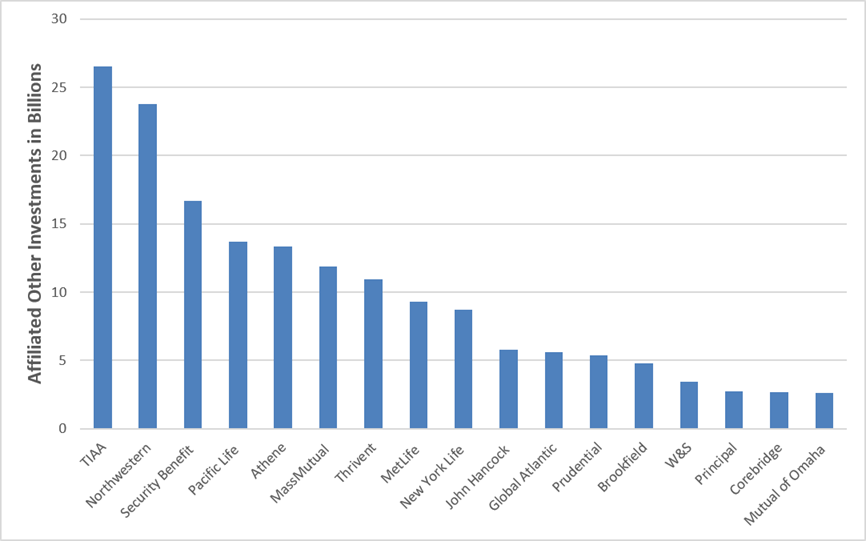
In the list are the ones you’d expect to see – Security Benefit, Athene, Global Atlantic and Brookfield – plus a whole bunch of other ones you probably weren’t expecting. The reason is that vertical integration isn’t just relegated to insurers owned by asset managers. It goes the other way around, too, with asset managers owned by insurers. TIAA, Pacific Life, MassMutual, Thrivent, MetLife, New York Life, John Hancock and Principal all have large positions in funds created by their in-house asset managers. Their books look remarkably similar to Athene and Global Atlantic. The outliers are Security Benefit and Brookfield, which are dominated by collateral loans to affiliates, and Northwestern Mutual, which has large positions in three non-insurance subsidiaries.
If we were to take a more expansive view of affiliation by including any asset where the insurer has an ownership stake in the asset manager, the numbers would be substantially larger. New York Life, Northwestern Mutual, Guardian, Prudential, MetLife and TIAA have all taken large minority positions in specialty asset managers over the past few years. Blackstone and Bain Capital have taken minority positions in Corebridge and Lincoln, respectively. The goal in all these transactions is to bring debt origination and placement closer together. Vertical integration is almost a requirement to be competitive in a world where the best opportunities occur in private market transactions.
The second largest category of affiliated assets is common stock. For most insurers, affiliated common stock consists almost entirely of subsidiary insurers. New York Life, for example, has $13.5 billion of affiliated common stock on its balance sheet, all of which is related to four subsidiary stock life insurance companies. Mutuals also occasionally have holding companies for certain wholly owned assets that show up as affiliated common stock. There are also a few examples – Sammons, F&G, Prudential, Brookfield – where affiliated common stock is dominated by equity positions in funds created by affiliates, often for mortgage positions. Because affiliated common stock is so dominated by subsidiary life insurers, we’re removing it from the analysis just to keep things simple.
If we switch the lens to affiliated bonds, the third largest category, we see a whole crop of new carriers show up. For this graph, we’re looking at affiliated bonds as a percentage of total bonds because Schedule D fixed income assets are the core asset for almost every insurer, so the comparison between affiliated and non-affiliated is more meaningful than comparing Schedule BA assets, which may or may not be a big portion of the overall asset mix.
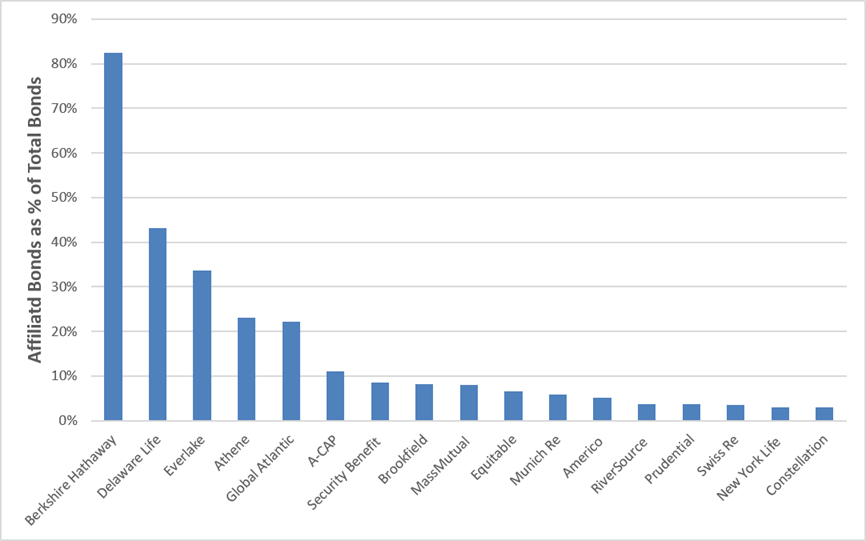
The number one user of affiliated bonds is Berkshire Hathaway by a country mile. This should come as no surprise. The entire playbook at Berkshire Hathaway has been using insurance assets to invest in operating businesses. In fact, 83% of the $3 billion bond portfolio at Berkshire Hathaway is comprised of debt to just three affiliated operating businesses – Lubrizol, Pilot and Berkshire Automotive. Yup, that’s it. I wonder if those entities were to read Dodgers, Lakers and Cadillac F1 if Berkshire would have made the news. Similarly, MassMutual, Equitable and Munich are dominated by loans to holding companies that own operating businesses.
The affiliated bond holdings of Everlake, Athene, Global Atlantic, Security Benefit and Brookfield are all dominated by positions in affiliated Asset Backed Securities (ABS). Structured credit like ABS requires the creation of special-purpose vehicles (SPVs) to hold the individual credit positions. If that SPV is controlled by the insurer, then it counts as an affiliated bond holding, even though the underlying credit positions may not be affiliated with the insurer. The inverse can be true, though – if the underlying credit positions of an ABS are affiliated with the insurer, then the positions could be counted as affiliated. In either case, these sorts of structures are designed to create a standardized risk profile through tranching that is held on an insurer’s balance sheet at a reliable rating with correct risk capital, regardless of whether the actual underlying credit is affiliated or not.
That brings us back around to the big outlier – Delaware Life. The bonds on its balance sheet are to ambiguously named LLCs with seemingly no connection to operating businesses or other parts of the enterprise. It is very difficult, in other words, to know where the money is going. If you were to just scrape the names of the bonds of all the insurers, Delaware Life would immediately look out of place. Unlike with ABS, each individual bond position has to be rated individually. The Wall Street Journal reported that no company has relied on private letter ratings more than Delaware Life and its sister company, Clear Spring Life. ABS provides for protection in the form of diversification and tranching, including an equity tranche. Straight bonds are just pure credit risk. And, in this case, pure credit risk rated by an agency that is under quite a bit of scrutiny from the SEC.
The only point of comparison is Security Benefit, which also lists a raft of ambiguously named LLCs – but unlike Delaware Life, Security Benefit has been incredibly clear about its investing strategy. It uses collateral loans to operating businesses of Eldridge Industries and identifies them as affiliated assets with the approval of its domestic regulator. You’d expect to see a bunch of ambiguously named LLCs because that’s what large companies call their subsidiaries. Pull any organizational chart for any major insurer and you’ll see dozens and sometimes hundreds of weird subsidiaries for different investments, holdings and businesses. The names don’t matter because these aren’t entities designed to attract third party investors. The people who need to know what they are certainly do. The same goes for Security Benefit making collateral loans to the raft of entities owned by its parent.
However, that sort of ambiguity isn’t what you want to see for unaffiliated bond positions on the balance sheet of an insurer, which is how Delaware Life was categorizing these positions prior to June. Presumably, someone at Delaware Life knew the nature of these LLCs and could gauge the quality of the investment. Surely, someone was doing due diligence. Someone could explain what each one of those loans was doing. Right? I mean, surely. But if the media reports are true, it seems that Delaware Life didn’t even know those assets were affiliated. So why in the world were they investing in them? Who was actually making that decision, if not Delaware Life? Even though there is no evidence that the assets are underperforming, the idea that Delaware Life was investing in things it didn’t even know were affiliated is a governance problem unto itself.
It is also potentially a symptom of what happens in a complex, intertwined corporate structure that is comprised of insurance and non-insurance businesses. Vertical integration has downsides, as we discussed in detail in #462, chief of which is the potential for misaligned incentives. Ideally, the owner of the asset manager and insurer should be interested in creating outcomes that benefit both. But if the value of the owner’s equity tilts towards the asset manager, there is a greater incentive to favor deals that benefit the asset manager at the expense of the insurer. In that scenario, the insurer could become a dumping ground for low-quality, high-risk or otherwise unmarketable assets. Those fears have been stoked by some of the reporting on Delaware Life despite the fact that there are (as of now) no specific examples of obviously low quality assets being parked at the insurer.
The challenge is that from a distance, it’s impossible to see the difference in water quality between a pristine Alpine lake and a toxic pond at the bottom of a quarry. They both look almost supernaturally blue. The only way you can really know is by looking at what’s above and around the water. The quality of the watershed is the best indicator of the quality of the water.
Consider the blue waters of 777 Re. If you were to look at the actual asset names in 777 Re’s portfolio, you would have no idea what they were. As we covered in a previous post, the only characteristic of those assets was that they were sitting on insurer balance sheets at 100 cents on the dollar with investment-grade ratings. Only by looking at the very public investing activities of 777 Partners – the watershed for the lake – could we deduce the nature of the assets on 777 Re’s balance sheet.
As 777 Partners became increasingly tangled up in money-losing sports teams, a failed bid for Everton, bankrupt airlines, creditor disputes and money being lent for personal use, it became clear that some of those investments were being funded primarily by premium flows from A-CAP entities to 777 Re. In the aftermath of 777 Re being put into administration and A-CAP’s disputes with its regulators and a spate of downgrades, it is abundantly clear now that the blue water of 777 Re was, in fact, a dumping ground for toxic 777 Partners’ investments.
When 777 Partners went on a buying spree of high-profile sports assets, one might argue that the leadership there was trying to run the same playbook that Mark Walter had successfully run years before, beginning with the purchase of the Dodgers. The difference is that 777 Partners, by all accounts, squandered money on bad sports assets. Mark Walter seems to have successfully invested in very good ones.
The question that remains unanswered is why, as many media outlets have reported, his organization seemed to go through such great lengths to obscure the affiliated nature of the investments. Was this just a way to open investments up to all the past and present Guggenheim entities and insurer clients, including EquiTrust and Sammons? Is this a technicality about the definition of affiliation? Was this a concerted effort to hide the size of certain bets? Was it all just one big misunderstanding? As of right now, we don’t have any clear answers. All we know is that Delaware Life has yet to be downgraded, claims are being paid and the plan of divestiture is being executed post-haste. But so far, the story seems to be mostly TMZ and not CNBC – at least not yet.