

#464 | Life Insurance Taxation in Context

We are thrilled to announce that TLPR has a new Comments feature which is now active and appears at the end of all our articles—both previous and current. We encourage you to leave your thoughts, questions, and opinions for us and fellow subscribers. We will do our best to respond, as appropriate, whenever possible. All comments are moderated by Paul Hanley, our newest Editor.
Matthew 22:21 – “Render therefore unto Caesar the things which are Caesar’s, and unto God the things that are God’s.”
The hottest story in life insurance right now is probably also its most controversial – Private Placement Life Insurance (PPLI). Bloomberg has been covering PPLI fairly extensively since at least 2021, when it published an article entitled “The Latest Tax-Avoidance Trick Probably Isn’t for You” that was entirely focused on PPLI, and giving PPLI a mention in its Wall Street Tax Trades series earlier this year. Just last week, the Wall Street Journal dropped an article entitled “’A Roth IRA on Steroids’: Wealthy Americans Find Another Tax-Free Way to Invest.” Life insurance hasn’t attracted this much press in a very long time – and that’s not entirely a good thing.
As hot and controversial as it may suddenly be, PPLI is not a new story. The first article we published on PPLI was #3 all the way back in 2012. We followed it up with another article in 2021 (#288) and discussed it in 2022 as well (#315 and #316). One of the core arguments we made in those articles is that although PPLI is life insurance, it’s not really a part of the retail insurance market. PPLI loves to position itself as an investment wrapper, not as insurance. A wrapper only available to ultra-wealthy, ultra-sophisticated folks. Definitely not insurance – except when it needs to be insurance for the tax treatment that drives the entire story. PPLI is like the sibling that left the country town to strike it rich in the big city and deploys a country accent only when convenient.
For a long time, it wasn’t entirely clear how much premium was actually going into PPLI. Zurich and Lombard periodically submitted their sales to LIMRA between 2015 and 2022. At the time, Lombard was the dominant player for onshore PPLI sales, but they never posted more than a couple hundred policies in a year with an average premium of around $1 million per contract. These days, Prudential seems to be the onshore juggernaut. They seem to be reporting PPLI in a particular category in the VUL sales data which shows some pretty astounding numbers in 2025: $680 million in premium across just 291 policies—which works out to about $2.34 million per policy. PPLI accounted for more than half of Prudential’s overall accumulation VUL sales in 2025. A similar phenomenon is playing out at Pacific Life where overall VUL premium grew by 70% and average premium is up by the same amount, meaning policy counts are flat. That’s almost certainly due to their PPLI offering.
The growth we can see in the sales data lines up with what it feels like in the marketplace, as well. Winged Keel has emerged as the dominant PPLI broker with a national footprint made up of high-end producers that used to be independent but have now joined the juggernaut. I regularly see PPLI being sold to high-net-worth individuals but, increasingly, also being pitched to partners at major law and accounting firms in so-called POLI transactions. The sheer number of insureds and flow of premium in those deals is staggering but, more importantly, the fact that sophisticated advisory firms are using it for their own partners validates the strategy. PPLI isn’t a fringe thing. It’s real. High net worth people actually want insurance and are trying to buy it. It’s a miracle. Pigs can fly.
Except these pigs aren’t insurance pigs. They’re investment pigs. The pitch for PPLI has been and remains very simple – PPLI is a “wrapper” for investments that provides advantageous tax treatment. That’s the short version of the story in virtually every PPLI pitch deck I’ve seen. There used to be a time when PPLI was pitched as “institutionally” priced life insurance on the merits of lower costs but, as we covered in previous posts, PPLI isn’t actually priced lower over the long run than a retail product. A typical PPLI policy sports a 1% premium-based broker compensation and asset-based fees of up to 50bps, which is usually split between the broker and the carrier. That’s a much higher long-term expense load than in a normal retail product.
But that misses the point. Traditional retail products can’t offer sexy investment options only available to accredited investors. That’s the sole domain of PPLI. The point of PPLI is to put those tax-inefficient, high-growth assets in a place where they can defer tax incidence or avoid it altogether. The cost of doing that – 25bps or so to the carrier, 25bps or so to the broker – plus the state premium taxes (if any) and mortality costs are well worth the tax savings. The insurance is incidental. There could be no insurance and PPLI would probably sell the same amount, even at the same all-in expense ratio, if the tax treatment were the same.
The positioning of PPLI as a tax wrapper has always been a reputational risk but, for a long time, PPLI wasn’t a big enough part of the market to attract much attention. As sales grew, so did awareness and publicity – and unwanted attention from legislators. In August of 2022, Senator Ron Wyden of Oregon opened up an inquiry into PPLI. The report from his office was released in 2024 and it showed a keen understanding of how PPLI is sold and positioned. Later that year, a discussion draft of a bill addressing PPLI was circulated, and it became a formal bill in April of this year. It strikes directly at the heart of PPLI by creating a new section in 7702 specifically for policies sold only to accredited investors and would essentially eliminate PPLI as we know it.
Senator Wyden has a long history of opening up inquiries into high-profile tax issues. We have no idea whether the bill will go anywhere. But what we do know is that PPLI is suddenly very much on the national radar. The result has been a huge uptick in PPLI awareness and sales. The logic goes something like this: “If Wyden is after it, then it must be good and we should get it before it’s gone because these policies will be grandfathered”, even though Wyden’s bill explicitly says that existing policies will be affected. Why not take the risk? Worst case, the positions have to be liquidated and exchanged to a new policy that isn’t targeted by Wyden’s bill.
But a close read of Wyden’s bill points to another angle. There are actually two layers of the qualification to determine the tax status of the policy. The first is that a policy qualifies as a Private Placement Contract (PPC), in that it is only available to accredited investors and sold through a private placement memorandum. This is the same requirement as for PPLI, and doesn’t change the tax treatment of the policy. It’s just a criterion that sets up the second layer, which is the qualification of a policy as an Applicable Private Placement Contract (APPC). This is a very different stipulation than anything else in Section 7702 which states that there must be at least 25 contracts within a pool that are supported by every asset in the account in the same exact proportion as all the others. If fewer than 25 contracts use any of the available investment allocations, then the presumption – although there is still some ambiguity – is that those contracts all become APPCs and lose their status under the tax law as life insurance.
The structure of Wyden’s bill raises a fundamental question – is PPLI being targeted because of perceived tax advantages of life insurance, or because of customized investment structures? Wyden was very careful not to target retail insurance policies with his bill. The official name is the Protecting Proper Life Insurance from Abuse Act. What is “proper” life insurance? Based on the APPC definition, proper life insurance doesn’t have custom-tailored investment strategies, which makes Wyden’s bill seem less about tax treatment and more about customized investment structures.
This speaks to the evolution of PPLI over the past few years away from traditional Insurance Dedicated Funds (IDFs) and towards Separately Managed Accounts (SMAs). SMAs are managed independently by the advisor and can hold individual positions in securities. They’re a common tool that RIAs use to essentially build customized portfolios for wealthy clients. With PPLI, the RIA can simply create a clone version to go in the PPLI as long as it satisfies the investor control and diversification requirements for life insurance funds. SMAs allow for a copy/paste approach to PPLI allocations, which means that the conversation really is as simple as whether or not it makes sense to “wrap” the SMA in life insurance.
SMAs also open up a lot of gray area. How independent is an SMA that is custom tailored for a single family by their advisor? What about if some of those positions in the SMA are actually controlled by the client? There are a lot of PPLI pitches from lesser-known carriers that revolve around putting “edgy” assets into PPLI like art collections, private businesses, sports cars – you name it. The big carriers won’t take that sort of thing. But what about if some of those assets work their way into an SMA in a life insurance policy? That’s harder to police. The concern is that some of those assets generate a lot of tax incidence but can be secretly ensconced in a PPLI policy.
That’s what Wyden’s 25-contract requirement seems intended to target. SMAs are, by their nature, customized for a small group of contracts, usually for the same family. IDFs, by contrast, are meant to be open-ended with a multitude of investors. By targeting SMAs, Wyden is going after the investment angle of PPLI, not the general tax angle. That’s good news for retail insurers/policies because they are, quite clearly, not in scope. Retail variable policies use Variable Insurance Trusts (VITs) with independent fund boards. They are about the furthest thing from SMA you could imagine short of a general account. It’s not a surprise that the insurance industry didn’t line up against Wyden on this one. Sacrificing SMAs in PPLI seems like a small price to pay to keep the overall retail life insurance franchise humming.
Even if the substance of the Wyden bill is targeted at SMAs, the headline is still that PPLI – and by extension, all life insurance – has certain tax advantages being exploited by wealthy people. The industry’s greatest latent fear is that, one day, legislators in a tight budget cycle will “remove” those tax advantages in one fell swoop. The good news is that those advantages aren’t written in explicit language that can be easily removed. They’re simply a function of the mechanics of the tax code. Messing with the mechanics of the Code’s treatment of life insurance would be an enormously complex undertaking. That alone should theoretically keep life insurance out of scope. It’d be a lot of hassle for not a lot of tax yield.
But the even better news – as weird as this sounds – is that life insurance doesn’t actually have much in the way of unique tax advantages. The reason there isn’t a section of the Code outlining the special advantages for life insurance is because there aren’t any. Instead, life insurance is taxed remarkably consistently with other assets and events. Changing tax treatment for life insurance would imply changing tax treatment for a host of other things.
Consider something as simple as Section 101, which states that the death benefit of a life insurance contract is paid without income tax incidence. While all life insurance benefits are paid tax-free, the difference with a permanent life insurance policy is that it will pay a claim at some point. In a sense, it’s not really insurance but, rather, a financial instrument with a mortality-contingent asset component (the Net Amount at Risk) and an asset component that earns a yield (the cash value). The fact that a policy with a certain payout eventually converts entirely to a liquid asset with a market-rate yield without tax incidence feels like an advantage.
It’s not. If the client owns an asset such as stocks, collectibles or real estate for 50 years, never liquidates it and then dies, the heirs get a step-up in basis. If they sell the asset immediately after the original owner’s death, they won’t pay taxes on any of the gain that has accrued over the past 50 years. The net effect of holding an asset and buying a life insurance policy is the same – they both have a tax-free benefit to the heirs. Both sides of the insurance equation are covered. The mortality-contingent piece – the actual insurance in the form of Net Amount at Risk – is tax-free like every other type of insurance benefit. The yield-bearing asset effectively has a step-up in basis. Section 101 covers both of those by simply saying that the entire death benefit is income tax free.
But what about the fact that there is no tax incidence on cash value growth? That’s consistent with how the Code treats many other assets for which there is no tax on unrealized capital gains. Cash value that grows over time isn’t taxed, either. If an asset is collateralized, it doesn’t trigger realization for the purposes of calculating tax incidence. The same goes for life insurance, regardless of whether you use a policy loan or a third-party bank loan. The tax treatment of life insurance cash value is consistent with other assets with similar characteristics.
Life insurance does have advantages, but they aren’t as flashy as the headline of tax-free death benefits and cash value growth. An obvious one is that basis comes out first before gains. This allows for partial surrenders / withdrawals from the policy rather than using policy loans. But is that really an advantage? Borrowing from a policy with a wash loan provision creates almost exactly the same effect as withdrawals but preserves the ability to repay the loan and restore the policy to its original state.
A less obvious – but much more powerful – advantage is that tax treatment for life insurance is handled at the contract level, not at the asset or fund level. As a result, assets can be reallocated within the contract without triggering tax incidence. To not pay tax on gains in other assets, you have to hold the asset itself. For life insurance, you can trade the underlying assets as much as the carrier will allow. It doesn’t matter. You won’t get a tax bill for doing it as long as the policy stays inforce.
The same applies to distributions. If a mutual fund or an ETF kicks out a taxable distribution, there is immediate tax incidence to the fundholder. But in life insurance, the distribution goes to the separate account holdings but doesn’t require a distribution from the contract itself. As a result, the distribution isn’t immediately taxable to the policyholder. Holding assets outside of life insurance almost always entails unexpected tax incidence. But in insurance, all tax incidence is entirely at the contract level and, therefore, dependent on what the policyholder decides to do with the contract. The real tax advantage of life insurance isn’t tax avoidance – it’s tax control.
And it only really matters for VUL. Buying a Whole Life policy is essentially investing in a single fund for life. The same goes for Universal Life. Even Indexed UL, arguably, is a single fund structure. Only VUL has the ability to truly reallocate in and out of funds and receive distributions in a way that would normally be taxable but aren’t in life insurance. For PPLI, that’s a particularly powerful advantage because of the big, lumpy liquidity events inherent in alternative investments. Putting those in life insurance eliminates immediate tax incidence of those events, which is an enormous benefit for those types of assets. That’s what makes PPLI such a powerful tool for tax control.
However, there’s a tradeoff that also only really applies to variable products with separate accounts. Assets held outside of a life insurance policy can be taxed as Capital Gains at lower rates than Ordinary Income. But in a life insurance policy, there is no such thing as Capital Gains. All gains are pure Ordinary Income. There’s a tradeoff – if you want contract-level tax treatment so that you can do asset-level reallocations without tax incidence, then you’re going to be stuck paying contract-level taxes at Ordinary Income versus asset-level taxes that could be Capital Gains. The question of the ultimate tax bill, therefore, is dependent on the circumstances. It’s not unambiguous, especially for Variable Annuities. Life insurance, in this case, has advantages but it also has a distinct downside.
This begs a bigger question – even if life insurance doesn’t have any special tax advantages, is it being used for cash accumulation in a way that wasn’t intended by the IRS? There’s a real case to be made that the answer is yes. Life insurance, in the eyes of the IRS, is always and forever only about death benefit protection. Cash value is a necessary mechanical component of a permanent insurance policy. The Cash Value Accumulation Test dictates an exact amortization of the death benefit into cash value such that the two equal each other at the end of the maturity period. Every single paid-up Whole Life policy follows that same slope. The Guideline Premium Test sets up funding levels that will ensure the policy stays in-force for life.
By every indication, the IRS very intentionally set up the parameters of Section 7702 to allow for just the right amount of cash value to maintain the policy for life – but, theoretically, no more than that. Whole Life actually still works that way. The base guarantees of a paid-up policy follow the CVAT slope. Each paid up addition buys a little slug of insurance that also follows the CVAT slope. The reason that works for Whole Life is because reinvested distributions don’t incur tax incidence. That allows a participating Whole Life policy to grow over time through reinvested dividends while still hewing to the fundamental design of 7702 that requires cash value to explicitly support death benefit.
Universal Life is much trickier. CVAT relies entirely on guaranteed Cost of Insurance charges and interest-crediting rates. GPT also accounts for current non-COI policy charges to calculate the premium limitations. But the big factor for either test is the guaranteed interest rate component which, these days, can be as low as 2% for the purposes of 7702 tax calculations. In the real world, the policies are crediting much more than that. As a result, cash value accrues in the policy that is far in excess of what is strictly required to keep the policy inforce because, unlike Whole Life, interest credited to Universal Life doesn’t also increase the death benefit. In other words, Universal Life can build cash value that is unrelated to the death benefit. Whole Life can’t.
You can actually see this playing out if you compare identically funded Whole Life and Universal Life policies illustrated at comparable rates. Every dollar of cash value in excess of the guarantees is linked to additional death benefit in a Whole Life policy. But in Universal Life, cash value is divorced from the death benefit* until it hits CVAT corridor.
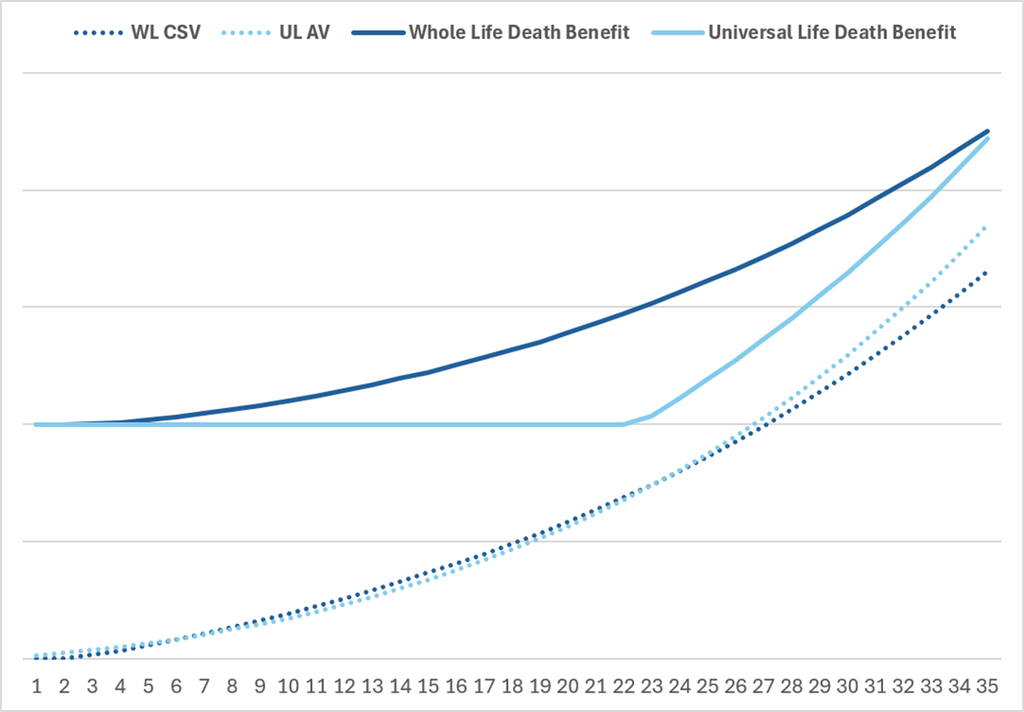
As a result, from the standpoint of a pure tax wrapper, Universal Life is a better structure than Whole Life precisely because it can produce excess cash value growth without directly affecting the death benefit. That keeps the pure insurance cost lower as a percentage of the account value than a Whole Life policy. Universal Life gets the benefit of using non-guaranteed elements in product values with guarantees-based tax limitations. Whole Life, however, must calculate with guarantees for both product values and tax limitations, which creates more death benefit initially per dollar of account value than in Universal Life.
Universal Life also has the advantage of being able to use the Guideline Premium Test (GPT) whereas Whole Life structurally can only use CVAT. The long-term advantage of GPT is lower corridor factors than CVAT, but with the short-term tradeoff of premium limits that don’t apply under CVAT. Under the current 2% 7702 Rate regime, maximum premiums under GPT are meaningfully less than the maximum non-MEC premium that would be available under CVAT. That means more initial death benefit needs to come along for the ride if you want to use GPT and, on top of that, the death benefit has to be structured as Option 2/B/Increasing versus Option 1/A/Level for CVAT. That creates more initial drag from the death benefit.
But in the long run, the lower GPT corridor creates slightly less drag from the insurance component. In retail scenarios, I’m a fan of using CVAT for accumulation designs because it’s simpler. You don’t have to switch the death benefit option in the future or do a face amount reduction in order to get an efficient policy. But in the context of PPLI, where every basis point of drag matters, GPT has the upper hand. That’s going to become even more true when the 7702 rate goes back up to 3%, which will widen the CVAT corridors and create more parity between maximum non-MEC premium and the Guideline premium limits. No matter what way you cut it, Universal Life as a “tax wrapper” is a cleaner story and more efficient structure than traditional Whole Life if all you care about is minimizing death benefit relative to account value.
This raises a fundamental question – if the IRS were to ever move against life insurance tax treatment, what would be the angle they’d use? It wouldn’t be to change 101(g) because an income-tax-free death benefit is consistent with other types of insurance payouts and the step-up in basis at death for other investments. It wouldn’t be to tax unrealized gains in the contract because that would be inconsistent with how unrealized gains are taxed in other investments. The same goes for tax-free collateralization of the cash value. It also wouldn’t make sense to put in trading limitations for life insurance because that would only apply to VUL and not fixed contracts.
The beautiful thing about the so-called “tax advantages” of life insurance is that, in fact, they aren’t tax advantages at all. The individual components of life insurance are all taxed exactly how many other asset classes and insurance contracts are taxed. The power of the chassis is for controlling tax incidence on assets that otherwise would create current tax drag, whether through periodic distributions, asset turnover, or liquidity events. It’s the ability to park assets in life insurance forever what would otherwise be exposed to periodic taxation.
The easiest method the IRS could use would be to look through the contract to the underlying investment and tax gains as they appear. For fixed and indexed contracts, that would mean a tax on every dividend or interest credit. For variable contracts, that would mean taxing the underlying investments the same as they would be taxed outside. This sort of structure already exists in annuities. A Variable Annuity has the traditional tax treatment at the contract level, but a Contingent Deferred Annuity allows for guaranteed income benefits to be layered on top of a taxable account, which essentially unwraps the assets that would be otherwise wrapped in VA.
It’s conceivable that the same structure could work for life insurance, but there would be a fundamental disconnect between the untaxed nature of the death benefit and the taxable nature of the cash value. In the eyes of the tax code, cash value exists for the sole purpose of supporting the death benefit. The only way to create a permanent insurance contract with a level premium is to have a reserve for the death benefit which, by the way, is also held tax-free at the insurer. If the death benefit is tax free, then cash value reserve should grow tax free as well. It’s logical and consistent. It makes more sense to unwrap the assets in an annuity because the benefits are always ultimately taxable. But in life insurance, that’s not the case – and, as a result, it doesn’t make sense to unwrap the asset.
Instead, the most straightforward path for the IRS to tax life insurance appropriately would be to force all policies to comply with the philosophy that all cash value has to exist only to support a death benefit. Whole Life already does this out of the box, as we’ve discussed. The base values are on CVAT corridor if the policy is paid up and below CVAT if not. Non-guaranteed dividends buy little slugs of additional death benefit on the CVAT corridor.
But Universal Life has non-guaranteed charges and credits that drive actual performance. If the IRS required actual non-guaranteed charges along with the 2% 7702 rate to calculate the CVAT corridor, then you’d get a much wider corridor and, in the case of GPT and the maximum non-MEC premium, much lower maximum premium limits. It would likely put UL at a disadvantage to Whole Life in terms of pure drag from mortality expenses. Does that make sense? Probably not. There should be equivalence. But the differing structures of the products make that hard to happen in the real world. The fact that UL is a more efficient tax wrapper is, for lack of a better way to land the plane on this, just the way it is.
All of this goes back to the fundamental point – life insurance tax treatment isn’t inherently advantageous. It’s logical and consistent with other asset classes. Even if life insurance doesn’t have explicit or special tax advantages, that doesn’t mean it can’t be used advantageously. The asset classes that are only available in PPLI are perfect examples of where life insurance makes sense as a tax control strategy. Otherwise taxable distributions and liquidity events get rolled up underneath the tax treatment of the contract as a whole – an incredible advantage that is well worth the cost of mortality and expenses. The same is true for traditional mutual funds available in Variable UL products which, as we’ve discussed in previous articles. It’s also true for Whole Life, which serves as a fixed income alternative, thereby avoiding tax incidence of bond coupons that would otherwise be taxable.
Stripping away the advantageous uses of a policy with fair and reasonable tax treatment would be exceedingly cumbersome. It would require a complete rewrite of Section 7702, potentially create other tax ambiguities and would potentially have implications into how other asset classes are taxed. There is no such thing as a “quick fix” for a “tax trick” that isn’t actually a trick at all. Even Wyden’s bill points to the same conclusion by purposely excluding the tax treatment of standard life insurance and PPLI with appropriate investments. If the bill is enacted, the clear target will be improper investments being placed in PPLI policies. That’s the right target. As an industry, we should be supportive of any piece of legislation that reinforces the fundamentally logical nature of life insurance tax treatment while dealing with aggressive edge cases – and that includes Wyden’s bill.
*Unless you choose Option 2. But to keep things simple, we’re sticking with Option 1 for this article.